Secure Messaging in Family Law: What Parents and Professionals Need
11 min readBy the CoParent Navigator team

Secure messaging in family law means communicating about children inside a closed, access-controlled workspace that keeps every message in order and unaltered, instead of scattering them across personal texts, email and social media. For parents, it gives you a clean record. For mediators and attorneys, it gives you something readable to work from. Our own workspace is built around this idea: one secure place for co-parent communication and documentation, next to the parenting plan that sets the rules for how you talk.
TL;DR
- Secure messaging keeps co-parent communication in one protected, ordered record. Ordinary texting leaves you with scattered threads and hundreds of screenshots.
- Screenshots often fall short under state evidence rules, according to the ABA Family Law Section. A complete, ordered record is easier to use.
- No court certifies an app. Whether a message comes in still depends on your state's rules on authentication and hearsay.
- What you write matters as much as where you write it: brief, child-focused, calm, and written as if a judge will read it.
- Put the communication rules in your parenting plan so the channel is part of the agreement, not a fight.
Table of Contents
- What secure messaging means for co-parents
- Why screenshots and loose texts cause trouble
- How courts treat messages and app records
- Courts are ordering the channel itself
- Safety and privacy: what to check in any messaging tool
- Writing messages a mediator or judge can read later
- Put the rules in the parenting plan
- For mediators and family law attorneys
- Promo: one workspace for the plan and the conversation
- Our perspective
- FAQ
- Sources
What secure messaging means for co-parents
Three things separate it from ordinary texting or email.
Control over access. Your personal phone number, email and social accounts are open to anyone who has your device or password. A dedicated workspace sits behind its own login, and the better ones support multi-factor authentication, which asks for a second proof of identity beyond a password.
A record that stays whole. Texts can be deleted, edited out of a screenshot or lost with a phone upgrade. Structured co-parenting platforms preserve every message, prevent either parent from deleting or altering correspondence, and let a complete record be downloaded for court, as Dentons describes. Calendars, expense trackers and document storage in the same place also cut down on repeat texts.
A single channel for a single purpose. When all child-related communication runs through one space, there is no argument about whether a request was "sent" and no sorting a custody conversation out of a thread that also covers dinner plans.
For a family law professional, the benefit is the same seen from the other side: one organized record of what clients said to each other, not a folder of images.
Why screenshots and loose texts cause trouble
If you have ever scrolled through hundreds of messages trying to find one agreement, you know the problem. It is also a legal one. The ABA Family Law Section says screenshots often do not meet state evidence rules and recommends exporting past texts with dedicated tools so a lawyer can use them.
Volume is a second problem. A Nebraska practitioner points out that a message can be admissible but unpersuasive, and that a lengthy export with the key entries buried in hundreds of repetitive pages can be excluded or discounted under Neb. Rev. Stat. § 27-403. The lesson: keep the original intact, and keep your day-to-day exchanges short and on topic so that the important ones are easy to find.
If you already have a pile of old texts, our guide on saving text messages for court walks through it, and why 400 screenshots will not carry a case explains what a court-ready record looks like instead.
How courts treat messages and app records
Three terms come up again and again, so here they are in plain words.
- Relevance: the message has to bear on an issue in the case, such as a schedule, an agreement or a safety concern.
- Authentication: someone must show the message is what it claims to be and came from who it claims to come from.
- Hearsay: an out-of-court statement offered to prove its truth is usually excluded unless an exception applies. A statement by the opposing party is generally treated as not hearsay.
States follow the same pattern with different citations. In Georgia, the State Bar's Family Law Section explains that under O.C.G.A. § 24-9-901 digital evidence can be authenticated through witness testimony, distinctive characteristics, metadata, device extraction or a party's admission, and that messages sent by the opposing party are non-hearsay under § 24-8-801(d)(2). In Florida, appellate courts describe authentication under Fla. Stat. § 90.901 as a relatively low threshold, and printouts of electronically stored data, including co-parenting app text fields, can qualify as originals. The same source notes that failing to lay the foundation can still lead to exclusion.
Courts tend to view app records with confidence. One firm reports that timestamps showing when a message was sent, delivered and first viewed, along with certified PDF reports, help meet self-authentication standards. Still, a certified export does not automatically prove who wrote a message or that every statement is true. Nebraska's State v. Falcon (2025) is the reminder.
| Question | What it asks | Practical habit | |---|---|---| | Relevance | Does it matter to the case? | Keep messages about the children | | Authentication | Is it genuine and from the right person? | Use one account per parent, one channel | | Hearsay | Can it be used for its truth? | Other parent's statements are generally usable | | Completeness | Is the full exchange visible? | Preserve whole threads, not clips |
This is general information, not advice on your case. For admissibility in your state, ask your family law attorney.
Courts are ordering the channel itself
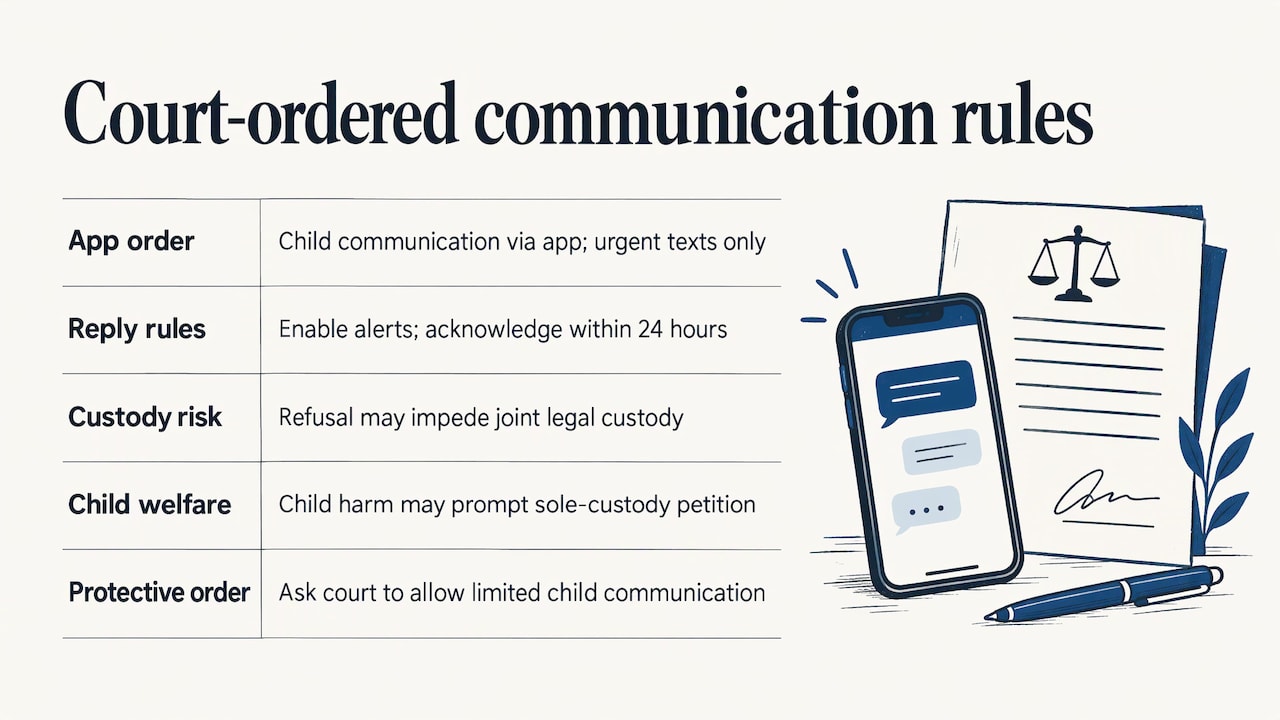
Secure messaging is no longer only a parent's choice. In January Term 2026, the Vermont Supreme Court in Freda v. Cunningham affirmed an order requiring the parents to use a co-parenting app for all communication about their daughter. Text messages were allowed only when time-sensitive, and the parents had to enable notifications and respond within set windows, including acknowledgment within 24 hours.
There is a custody angle too. Dentons notes that when one parent persistently refuses to engage in the app, courts may treat the pattern as an impediment to joint legal custody, and if the child's health, education or welfare suffers, the other parent may petition for sole legal custody.
If a protective or restraining order is in place, counsel can ask the court to modify it so limited communication about the children is expressly allowed. Courts routinely carve out scheduling, medical emergencies and exchange logistics, provided the parents use a mutually agreed medium and keep messages strictly to the children's needs. If this is your situation, talk to your attorney before sending anything.
Safety and privacy: what to check in any messaging tool
Security is not only about the other parent. The Safety Net Project, which works on technology safety for survivors of abuse, advises looking for:
- a plain-language privacy notice and clear consent requests;
- location features that are optional, not always on;
- a web portal you can use from a safe device;
- multi-factor authentication;
- clear policies on data retention, deletion and sharing.
The same Safety Net Project guidance warns that photos and videos carry metadata that can reveal date, time, location and device owner, and suggests checking the tool's metadata policy or stripping metadata before sharing images.
Our security and privacy page explains how our workspace approaches this, and our co-parenting app features checklist lists what else to weigh.
Writing messages a mediator or judge can read later
The channel gives you a record. Your wording decides what that record says. The Arizona chapter of AFCC (the Association of Family and Conciliation Courts) advises sharing information that is accurate, complete and timely, keeping messages brief and about present or future events, using one topic per message with a specific subject line, setting reasonable deadlines, replying within 24 hours and writing as if a judge will read it.
AFCC's Ask the Experts adds two habits: let a drafted message sit for an hour before sending, and use BIFF (Be Brief, Informative, Friendly and Firm). Treat the other parent as a colleague in a shared job, and never use the children to carry messages.
A worked example. Instead of:
"You're late again. This is why the kids hate switching houses."
Write:
"Exchange is Friday at 5:00 at school. Can you confirm you'll pick up by 5:15? If not, please let me know by 3:00 so I can arrange after-school care."
The second message states the plan, sets a deadline, assigns no blame and reads fine in a courtroom. For more drafting help, see our communication tips for successful co-parenting and how to set up communication channels.
Put the rules in the parenting plan
A secure channel works best when the agreement names it. A good communication clause covers:
- Which channel is used for child-related messages, and which uses (if any) are allowed outside it, such as urgent texts.
- Response times, for example acknowledgment within 24 hours and a fuller reply within a stated number of days.
- Topics: schedule, health, school, expenses. Not the relationship.
- Emergencies: how to reach each other when a child is hurt or sick.
- Quiet hours, so one message does not own your evening. Our pieces on the divorce email boundary and the co-parenting inbox fix cover this.
Make sure the clause also fits your state's rules. That is where a state-specific plan helps, and it is why we build plans around state law rather than a generic template.
For mediators and family law attorneys
Professionals face the same issue from the other direction: clients arrive with fragments. Structured communication gives you a cleaner picture of how the parents actually interact, which feeds directly into mediation preparation and into drafting. Our platform offers mediation preparation tools and resources for family law professionals to manage client communication. See our page for attorneys.
As the Nebraska guidance above stresses, preserve the original record and let counsel craft a fair presentation of it. A record that is orderly from the start makes that job faster.
Promo: one workspace for the plan and the conversation
CoParent Navigator lets one parent draft a complete, state-specific parenting plan independently, using a library of research-backed clauses, and keeps communication and documentation together in a secure workspace. That means the rules on how you talk and the place where you talk sit side by side, with less friction and fewer costly delays than the back-and-forth of traditional approaches.

If you are ready to put your communication rules in writing, create a custodial plan. If you are still comparing options, our comparison of co-parenting apps sets out what each type does best, and our free co-parenting tools are a place to start.
Our perspective
Most co-parenting conflict we hear about is not about the big decisions. It is about the small ones: who said what, when, and whether it was ever agreed. A message thread that lives on two personal phones turns each of those into an argument about memory.
That is why we think communication belongs inside the parenting plan, not beside it. When the plan says how you talk, how fast you reply and what counts as urgent, the channel stops being a battleground. And when one parent can draft that plan alone, the process does not stall waiting for a conversation that neither parent can face.
A secure workspace should reduce work, not add to it: one place for messages and documentation, plans that reflect your state's rules, and legal guidance that we update regularly. Calm, brief, child-focused messages written in a protected space are the best habit a parent can build, and the record they create tends to speak for itself.
Heather
FAQ
Is secure messaging the same as a co-parenting app?
Often, yes. A co-parenting app or workspace is the usual form of secure messaging: a protected account, an ordered record and tools such as calendars and expense logs. The label matters less than whether it preserves every message and limits access to the two parents.
Will a judge accept messages from a secure platform?
That depends on your state's evidence rules, because no court certifies an app. Records with timestamps and complete threads are generally easier to authenticate than screenshots, and the other parent's own messages are typically not barred as hearsay. Your attorney can tell you how your state treats them.
Can a court order us to use a particular channel?
Yes. Courts in several states order parents into a named app in conflict cases, and the Vermont Supreme Court upheld such an order in 2026. The order may also set response times.
What should I avoid putting in a message?
Avoid blame, sarcasm, old grievances and anything you would not want a judge to read. Stick to one topic, state the plan and give a deadline. Never use your children to carry messages.
Is it safe to use if there has been abuse?
Safety comes first. Look for multi-factor authentication, optional location features and clear data policies, and consider a safe device. If a protective order exists, speak with your attorney or a domestic violence advocate before choosing how to communicate.
Sources
- Co-Parenting Apps, Safety Net Project
- Co-Parenting Through a Separation, Dentons
- Using Technology to Find Answers to Common Child Custody Problems, ABA Family Law Section
- Can Co-Parenting Apps Be Evidence in Nebraska Custody Cases
- Family Law Review, Spring 2026, State Bar of Georgia
- Text Messages as Evidence in Florida Family Law, Brickell Legal
- Co-parenting apps: how courts view digital communication, Minella Law Group
- Freda v. Cunningham, Vermont Supreme Court
- Co-Parenting Communication Guide, Arizona AFCC
- Ask the Experts, AFCC
Recommended
- How to Save Text Messages for Court: A Parent's Guide
- Domestic Violence and Parenting Plans: Safety Provisions That Courts Recognize
- The Divorce Email Boundary That Saves Your Evenings
Informational only, not legal advice. Review filing, approval and enforceability requirements with a qualified professional in your jurisdiction.
Start building your parenting plan today
Build a complete parenting plan with CoParent Navigator, the child-centered way to a custody agreement that holds up.