Emergency Decision-Making in Custody: What Your Plan Should Say
12 min readBy the CoParent Navigator team

In a true emergency, the parent who has the child at that moment can act to protect the child's health or safety, then must tell the other parent quickly. Most parenting plans never say this clearly, so a hospital visit or a safety scare turns into an argument about who was allowed to do what. The fix is a short, specific emergency clause written into the plan before anything happens. Our platform lets one parent draft a state-specific plan with that clause already built from a library of research-backed language.
This guide covers what counts as an emergency, who decides, what to say afterward, what the clause should contain, and the separate step of asking a court for an emergency custody order when the existing plan is not enough.
TL;DR
- An emergency decision protects a child's health or safety right now. A schedule dispute, a school choice or a different set of house rules is an ordinary disagreement, not an emergency.
- Many plans let the parent with the child make emergency decisions whatever the decision-making split is, then require telling the other parent as soon as reasonably possible.
- Your plan should define "emergency," name who decides, set a notice deadline and say how to communicate, so nobody argues about it afterward.
- If a child faces immediate danger and the plan cannot protect them, you can ask a court for an emergency (ex parte) order. Standards, filing steps and deadlines differ by state.
Table of Contents
- What counts as an emergency decision
- Who decides, and what you tell the other parent
- What a strong emergency clause contains
- When the plan is not enough: emergency custody orders
- Emergencies across state lines
- Putting it in writing before you need it
- Build the clause into your parenting plan
- FAQ
- Sources
What counts as an emergency decision
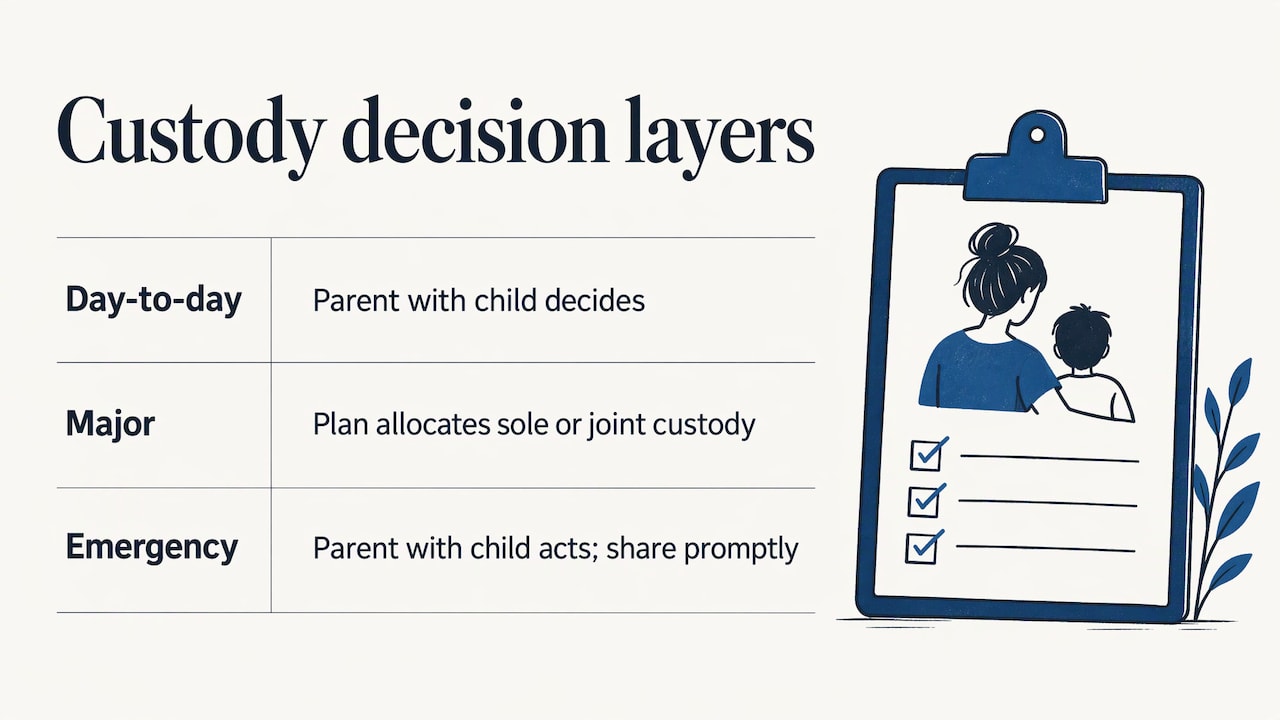
Custody plans split decisions into three layers. Day-to-day choices (meals, bedtime, homework) belong to the parent the child is with. Major choices (non-emergency surgery, school, religion) follow whatever the plan allocates, as sole or joint legal custody. If the difference between legal and physical custody is fuzzy, our explainer on legal custody versus physical custody sets it out.
Emergency decisions are a third layer that sits above the allocation. Florida's court-approved parenting plan form, for example, says either parent may make emergency decisions affecting the child's health or safety while the child is residing with that parent, regardless of how decision-making is divided, and must share the decision with the other parent as soon as reasonably possible.
The word that matters is immediate. Courts are careful about it. A Connecticut Superior Court decision cited by the Connecticut Judicial Branch's custody guide held that the state's emergency statute is meant for emergencies affecting a child's safety and welfare, not for settling parenting disputes, and that parents who do not co-parent well do not by that fact create an emergency.
Ordinary disagreement or emergency?
| Situation | Usually an emergency decision? | Why | |---|---|---| | Child has a broken bone or trouble breathing | Yes | Health at risk now; the parent present acts | | Child is in an accident or hospitalized | Yes | Treatment cannot wait for a conversation | | Other parent is impaired and about to drive the child | Yes | Immediate safety risk | | Choosing a new pediatrician | No | Major decision, follows the plan's allocation | | Switching schools mid-year | No | Major decision | | A late exchange or a disputed weekend swap | No | Scheduling issue, handle under the plan | | Different bedtime or screen rules | No | Day-to-day parenting |
The table is a general guide. Your state's wording and your own order control the answer.
Who decides, and what you tell the other parent
The working rule in most plans is simple: whoever has the child makes the decision needed to protect them. Florida's safety-focused parenting plan instructions say each parent makes emergency decisions affecting the child's health or safety while the child is with them, notifying the other parent at the earliest opportunity. The same instructions say to contact the other parent immediately in an emergency and to notify them right away of any serious illness, accident or hospitalization.
In practice, that means:
- Act first on what cannot wait. Call 911 or go to the emergency room. Do not stall treatment to reach the other parent.
- Call or text the other parent as soon as the child is safe. Say where the child is, what happened and what care is being given.
- Keep it factual. Record the time, the provider and the treatment. Leave blame out of it.
- Follow up on anything that continues. Ongoing treatment after the emergency is usually a major decision again and goes back to the plan's allocation.
A short, calm message is better than a long explanation. Something like: "Maya fell at the park and we are at St. Mary's ER. She is being examined for her wrist. I will update you at 6." That one message does what the clause requires and leaves little to fight about.
If your plan says nothing on the point, the usual expectation still applies, but you are relying on assumption. For high-conflict situations, that gap is where disputes start, and our guide to handling co-parenting disputes calmly covers the communication side.
What a strong emergency clause contains
A good clause fits in a paragraph or two and answers five questions.
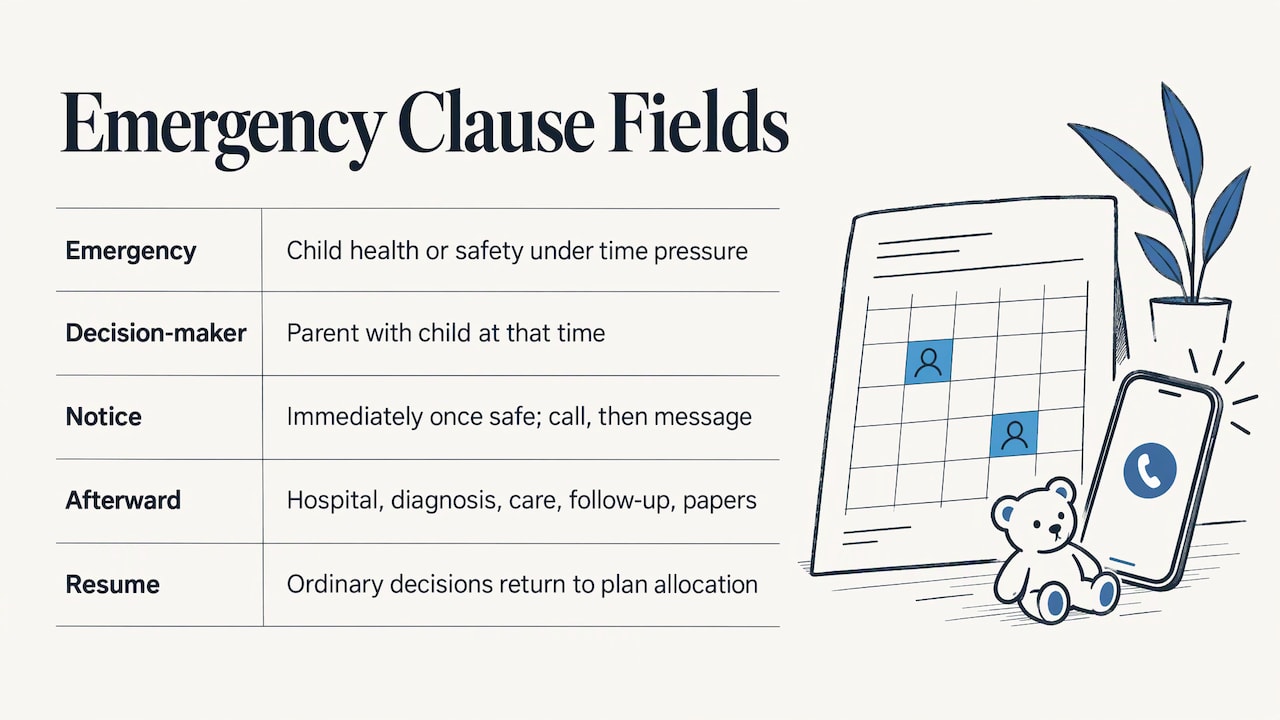
1. What is an emergency? Define it by the child's health or safety and the time pressure. Examples help: serious injury, sudden illness, hospitalization, an immediate threat to safety.
2. Who may decide? Typically the parent with the child at that time, regardless of whether legal custody is joint or sole.
3. How fast must the other parent be told? Name a deadline, such as immediately once the child is safe, and a method, such as a phone call followed by a written message.
4. What is shared afterward? Hospital name, diagnosis, treatment given, follow-up needs, and copies of discharge papers.
5. What happens to non-urgent follow-up? Say plainly that once the emergency passes, ordinary decision-making returns to the plan's allocation. If both parents must agree on major medical care, the clause should say so, and that is where a clear joint legal custody clause matters.
Also add a way to reach each other. Include a communication clause so that emergency notices go through a channel both parents will see, which our library covers under communication clauses for parenting plans. A plan that names the channel removes the "I never got your message" argument.
Mental health emergencies
A crisis is not always physical. A child, teen or parent in acute emotional distress may need urgent care, and the plan should treat it like any other health emergency. For adults trying to recognize when a situation is serious, see signs psychiatric care is urgent. If a child is in immediate danger of self-harm, call 911 or 988, the Suicide & Crisis Lifeline, without waiting for the other parent.
When the plan is not enough: emergency custody orders
An emergency decision lets you protect a child for a moment. An emergency custody order is different: it is a short-term court order, often called an ex parte order because a judge may issue it before the other parent is heard, that changes who has the child or limits the other parent's time. It is for situations where following the existing plan would put the child in immediate danger.
The standard is high and varies by state. The examples below come from official court and legislative pages.
| State | What must be shown | What follows | |---|---|---| | California | Immediate danger of irreparable harm, an immediate risk the child will be taken from California, or loss or damage to property | A judge may decide the same or next business day; any order lasts until the hearing | | North Carolina | Substantial risk of bodily injury, sexual abuse, or removal from the state to evade the courts | A hearing must be scheduled so both parties can be heard | | Connecticut | Immediate and present risk of physical danger or psychological harm, sworn in an affidavit | A hearing within 14 days of an ex parte order |
Some details are very specific. In California, the self-help guide says you use forms FL-300 and FL-305, give specific facts including incident dates for custody requests, file a UCCJEA declaration (form FL-105) and give notice under Rule 5.165. It lists a fee of $60, or $435–$450 if it is the first paper filed in the case. North Carolina's domestic violence statute provides that a hearing must follow within 10 days of the order or 7 days from service, whichever is later. Fees and rules change, so confirm them on your state court's page before filing.
Two practical points apply everywhere:
- Facts beat feelings. Courts look for specific, dated, first-hand facts. Police report numbers, medical records, dated photos and time-stamped messages are the kinds of records a judge can act on. Write down what you saw and when, and keep the originals.
- Emergency orders are temporary. They hold until a hearing where both parents are heard. They do not decide permanent custody, and a request built on an ordinary disagreement can hurt your credibility later.
If the danger involves domestic violence, your parenting plan should also carry safety provisions courts recognize; our library covers domestic violence and parenting plan safety provisions. For emergency filings, talk to a family law attorney in your state, or to the court's self-help center, about the exact forms and timing.
Emergencies across state lines
If the child is in a different state from the one that issued your order, jurisdiction gets complicated. Nearly every state follows the Uniform Child Custody Jurisdiction and Enforcement Act (UCCJEA), with Massachusetts the exception. Under UCCJEA section 204, a court can use temporary emergency jurisdiction when the child is present in the state and needs protection from mistreatment or abuse, even if only a parent was abused. That order is temporary, and the courts must communicate if another state has a case or order involving the same parties.
The lesson from case law is that emergency orders must be time-limited and coordinated with the state that has proper jurisdiction. North Carolina's 2025 judicial manual notes a 2023 appeals decision in which a court overreached by failing to contact the home-state court or set the order's length. If you move for an emergency order away from your home state, expect the process to be short-lived and to lead back to the state that issued your original order.
Putting it in writing before you need it
Most of the pain in emergencies comes from ambiguity, not from bad faith. A parent who takes a child to urgent care and gets accused of overstepping, or who is left out of a hospital visit, is usually responding to a plan that never said who does what. Writing the clause now costs little, and it makes any later dispute much shorter.
A clause also helps in mediation, where a neutral can turn a vague worry into agreed language. If you are heading into a session, our list of child custody mediation questions is a useful preparation. Once the plan is final, a well-drafted order is easier to enforce, which we cover in parenting plan enforcement.
Build the clause into your parenting plan
CoParent Navigator is a web-based platform for creating a personalized parenting plan tailored to your state's laws, using a library of research-backed clauses. One parent can draft the plan independently, which keeps friction and fees down. The secure workspace centralizes communication and documentation, so an emergency notice and the record of it sit in one place.

Start with the CoParent Navigator parenting plan builder and add an emergency decision-making clause that fits your state and your schedule. Attorneys and mediators can see how the platform supports client communication on the for attorneys page.
Our perspective
Parents rarely fight about the emergency itself. They fight about what came after: who was told, when, and whether the decision was theirs to make. That is why we treat the emergency clause as one of the most practical parts of a plan, not an afterthought.
Our platform is built so that one parent can draft a complete, state-specific plan without waiting for the other to agree to every word, using clauses designed around research and regularly updated legal guidelines. A clear emergency section, a named way to communicate and a documented record in a secure workspace take the guesswork out of the worst days. When the language is already agreed, a frightening night stays a frightening night, and does not become a court case.
Heather
FAQ
Can a parent with only physical custody make emergency medical decisions?
Generally yes, when the child's health or safety is at immediate risk and the plan allows the parent with the child to act. Florida's plan form is one example: it lets either parent make emergency decisions regardless of the decision-making split. Check your own order, since some require conferring first when time allows.
How quickly must I tell the other parent?
As soon as reasonably possible, once the child is safe. Official parenting plan instructions in Florida say to contact the other parent immediately in an emergency and to notify them right away of serious illness, accident or hospitalization. Putting a specific deadline and method in your plan removes doubt.
Is a disagreement over schooling or schedules an emergency?
No. Courts distinguish emergencies from disputes about parenting. A Connecticut decision cited by the state's judicial branch says that parents who do not co-parent well do not by that fact create an emergency. Those issues belong in the plan, mediation or a regular motion.
How long does an emergency custody order last?
Usually until a hearing, which comes soon after. Connecticut requires a hearing within 14 days of an ex parte order, and California sets a hearing to decide whether the order should last longer. The exact timeline depends on your state, so confirm it with the local court.
Sources
- Florida Parenting Plan Form
- Safety Focused Parenting Plan Instructions, Florida 12th Circuit
- Child Custody in Connecticut, Connecticut Judicial Branch
- Ask for an emergency (ex parte) order, California Courts
- Child Custody, North Carolina Judicial Branch
- N.C. General Statute 50B-2
- UCCJEA Guide for Court Personnel and Judges, NCJFCJ
- 2025 A/N/D Manual, Chapter 3, UNC School of Government
- Custody, WomensLaw.org
- When Psychiatric Care Feels Urgent: Signs and Next Steps
Recommended
- Joint Custody Plan: A Practical Guide for Families
- Create a Custodial Plan
- The Anatomy of a Strong Parenting Plan
- Parenting Plan for Court: What to Include and How to File
Informational only, not legal advice. Review filing, approval and enforceability requirements with a qualified professional in your jurisdiction.
Start building your parenting plan today
Build a complete parenting plan with CoParent Navigator, the child-centered way to a custody agreement that holds up.