Relocation Clause in a Custody Agreement: What to Include
11 min readBy the CoParent Navigator team

A relocation clause in a custody agreement sets the rules for a move before anyone is packing: how far counts as a move, how much written notice the other parent gets, when consent or a court order is needed, and how the parenting schedule changes afterward. A clause that spells out all four turns a future crisis into a process. A plan that says nothing leaves you arguing about it in court. CoParent Navigator lets one parent draft a state-specific parenting plan with a library of research-backed clauses, relocation included, so the rules are written down while both households are still stable.
TL;DR
- A good relocation clause defines the distance that triggers it, the notice period, how the other parent can respond, and how the schedule and travel costs change.
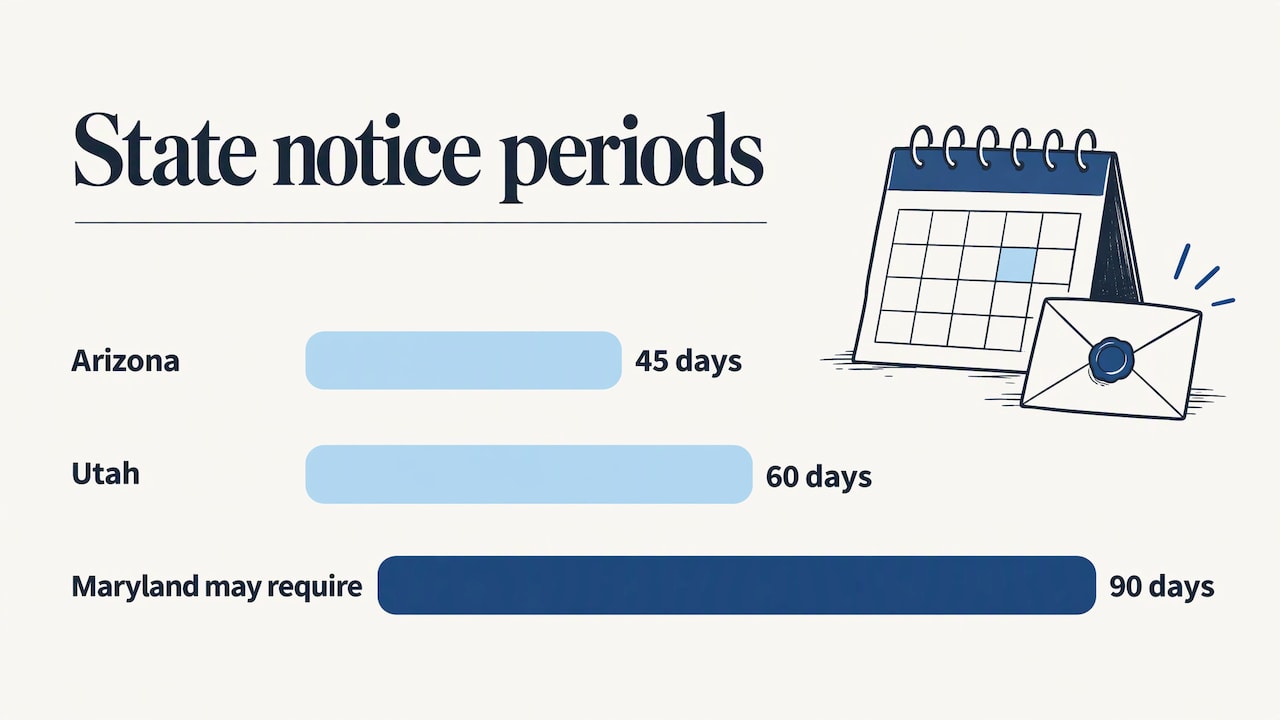
- State law sets the baseline, and the numbers vary widely: 45 days in Arizona, 60 in Utah, 30 in Indiana, 90 in a Maryland order that requires it.
- Check your state's statute first, then write a clause that matches or improves on it for your family.
- If parents disagree, a court decides the child's best interests. Documented notice and a realistic proposed schedule are what you bring.
- A clause drafted now is far easier than a move-away fight later.
Table of Contents
- What a relocation clause actually does
- What the clause should specify
- How the rules differ by state
- If the other parent objects
- Drafting your clause, step by step
- Our perspective
- Build your relocation clause
- FAQ
- Sources
What a relocation clause actually does
A relocation clause is the part of a custody order or parenting plan that governs a parent moving with the child. It answers a simple question: who has to tell whom, how early, and what happens if the other parent says no.
Without it, the default is usually the state statute or, in some places, a court request. The New York City Bar explains that when an order or agreement does not address relocation, the custodial parent must ask the court for permission to move with the child. That means weeks or months of litigation over a move that a clause could have handled in a few paragraphs.
California's court self-help guidance describes the options plainly: a custody agreement can specify when a parent must notify the other about a planned move and how far a move may go before consent is needed. That is the core of the clause. If you want the stakes spelled out, our library piece on why a plan that skips relocation can cost you walks through them.
What the clause should specify
Strong clauses are concrete. Vague wording like "reasonable notice" or "a significant distance" is where disputes start. Cover these points.
1. The distance or event that triggers it
Choose a measurable trigger. Statutes use miles, state lines or both. Utah defines relocation as a move of 150 miles or more from the other parent's residence. Indiana exempts a move that reduces the distance or increases it by no more than 20 miles while the child stays in the current school. Louisiana's rules, effective January 1, 2027, apply to an intent to establish the child's principal residence outside the state or more than 75 miles within it, measured by the shortest publicly accessible driving or ferry route.
For your clause, define how miles are measured (driving distance is easier to prove than a straight line), from whose home, and whether a school-district change counts even when the distance is short.
2. The notice period and what the notice contains
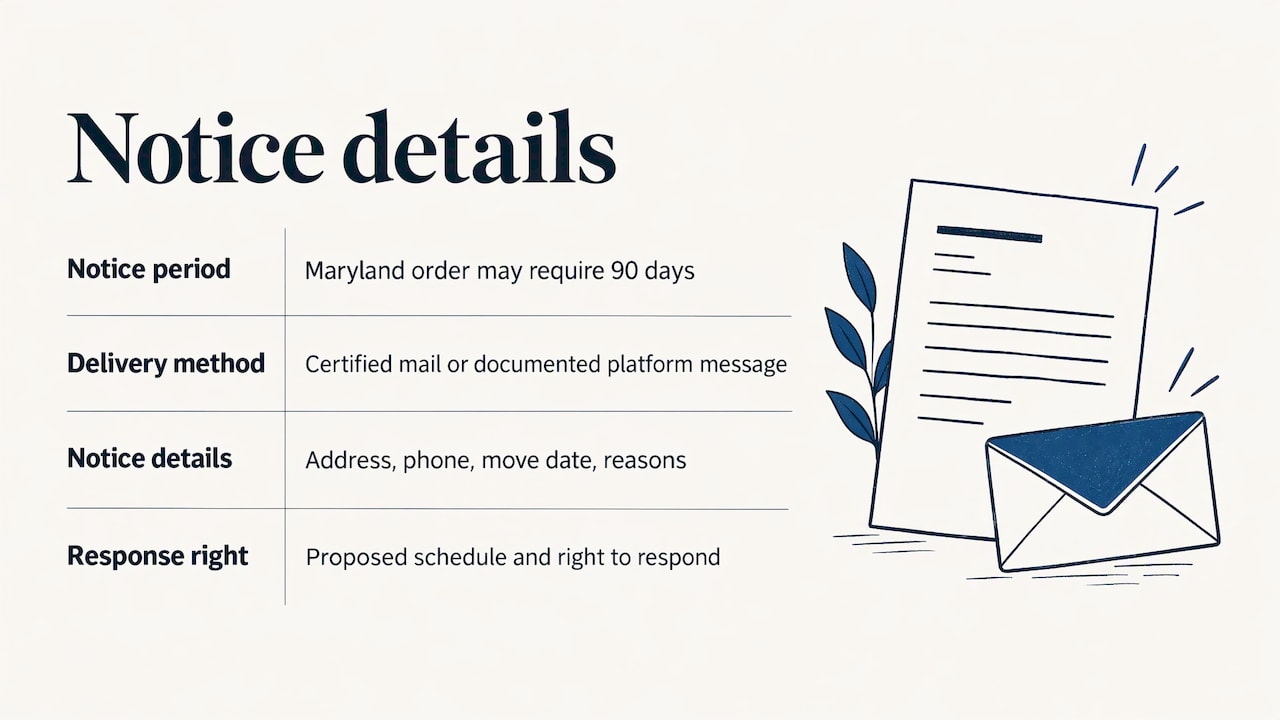
Write the number of days, the method (certified mail or a documented platform message) and the contents. Maryland allows a custody or visitation order to require at least 90 days' written notice of an intended permanent-residence move, and it lets notice be waived for abuse risk or other good cause. Indiana's statute lists what the notice must include: the new residence, phone number, move date, reasons, a proposed schedule revision and information about the other parent's right to respond.
Copy that checklist into your clause even if your state asks for less. A notice that arrives with a new address and a proposed schedule gives the other parent something to answer. A notice that says "we're moving in the summer" invites an argument.
3. How the other parent responds
Set a response window and the choices inside it. Indiana gives the nonrelocating parent 20 days after service to respond: no objection, a request to change the order, or an objection with a request for a hearing. Arizona gives the other parent 30 days to petition to prevent the move. Your clause can mirror these windows and add a requirement that silence is treated as a lack of objection only if the notice was delivered the agreed way.
4. Consent versus court approval
Decide in advance which moves need written consent and which need a judge. Many parents choose a tiered approach: a short move within the same school district needs notice only, a longer move needs consent, and any move out of state needs consent or a court order. Write what happens if consent is refused: usually the moving parent files a petition and the existing schedule stays in force until the court rules.
5. The new schedule and who pays for travel
The most useful part of a clause is the one that answers "what happens to the schedule?" before the fight starts. Utah's notice requires the relocating parent to affirm the parent-time schedule will be followed, that neither parent will interfere with the other's court-ordered rights, and the court may review schedules and transportation costs. Your clause can do the same: summer blocks, alternating holidays, video calls on set days, who books flights, who accompanies a younger child and how costs split. Our guide to a long distance parenting plan shows how those schedules are built.
How the rules differ by state
The baseline your clause sits on depends on where the order was entered. These examples show how much the numbers vary. Always confirm against the current statute or your court's self-help page.
| State | What triggers the rules | Notice | Other parent's response | |---|---|---|---| | Arizona | Out-of-state move, or more than 100 miles within the state, when both parents live there and have joint decision-making or parenting time | 45 days, written, by certified mail | 30 days to petition to prevent the move | | Utah | Move of 150 miles or more from the other parent | 60 days before the move | Parent with joint physical custody (111 or more nights a year each) must also file a petition to modify custody | | Indiana | Relocation, with exceptions for small distance changes where the child stays in school | Filed with the court no later than 30 days before the move or 14 days after learning of it, whichever is sooner | 20 days after service | | Maryland | Order may require notice of a permanent-residence move | Order may require 90 days | Expedited hearing if a petition is filed within 20 days of notice | | Louisiana | Out of state, or more than 75 miles within it, effective January 1, 2027 | See the statute | See the statute |
Sources for the Utah row include the Utah Courts self-help page. Laws are amended often; our summary of custody law changes in 2026 tracks what took effect this year.
One more point matters if you ever move across state lines. Forty-nine states and D.C. have adopted the UCCJEA, the uniform law on custody jurisdiction, and under it the original state generally keeps exclusive continuing jurisdiction as long as the child or a party remains there. Moving does not automatically move the case, so your clause can name which court handles disputes.
If the other parent objects
An objection does not mean the move is blocked, and it does not mean it is allowed. It means a court decides. Maryland requires an expedited hearing if a petition is filed within 20 days after required notice, or if the move would significantly interfere with the existing parenting-time schedule. Colorado, as one example, schedules hearings quickly after an objection.
What do judges weigh? Standards differ, but the themes repeat. Indiana places on the relocating parent the burden to prove the move is in good faith and for a legitimate reason. Arizona puts the burden of showing the move serves the child's best interests on the relocating parent and tells the court, to the extent practicable, to arrange for a continued meaningful relationship with both parents. New York courts look at each parent's reasons, the child's relationships, the effect on future contact, whether the move improves the child's life and whether visitation can preserve the bond, according to the New York City Bar.
The practical lesson: the parent who arrives with a concrete job offer, a school, housing, and a detailed long-distance schedule is in a stronger position than one who arrives with a plan to figure it out later. A parent opposing a move does best with an equally concrete picture of what the child would lose. A clause that requires these details up front makes both sides do this homework early, and often settles the matter before a hearing.
Drafting your clause, step by step
- Find your state's baseline. Read the statute and your court's self-help page for the notice period, trigger distance and response window. This is the minimum you build on.
- Pick your trigger. Choose a mileage number or school-based trigger, how it is measured, and whether in-state moves count.
- Set the notice terms. Days, delivery method and required contents: address, move date, reason, proposed schedule. Our platform's clause library gives you tested wording to start from, matched to your state.
- Define the response. A response window, the three possible answers, and what happens to the current schedule while the issue is pending.
- Write the long-distance schedule in advance. Summer, holidays, video calls, travel logistics and cost split.
- Name the dispute path. Mediation first, then the court that holds jurisdiction. Mediation goes faster when each parent has the same documents; see how our mediation preparation tools support that.
- Keep a record. Send notices and replies through one place that timestamps them, so nobody has to argue about what was said and when.
Families with a military parent should add deployment language too. Our guide to deployment clauses covers it, and Pennsylvania's Act 40 of 2025 now makes its relocation statute expressly apply to deployed military parents.
Practical details that follow a move
A move touches more than the schedule. Registrations, coverage and school records all change, and a clause can say who handles which. Even routine tasks such as handling car insurance when moving states belong on the checklist you share with the other parent, so the move does not become a second source of friction.
Our perspective
Most parents write a schedule and leave relocation for "if it ever comes up." It comes up. When it does, nobody is calm, and the only rules available are the ones on paper.
We built CoParent Navigator so one parent can draft a complete, state-specific plan without waiting for a long back-and-forth. That matters most for relocation, because the clause only works if it is written while both parents still trust the process. A drafted clause with a clear trigger, a notice checklist and a long-distance schedule gives the other parent something to react to, which is how low-conflict agreements actually get signed.
Rules also change. Our legal guidelines are regularly updated, so the clause you start from reflects your state's current law rather than a form someone saved years ago.
Heather
Build your relocation clause
CoParent Navigator is a web platform for creating a personalized, state-specific parenting plan from a library of research-backed clauses, with plan evaluation, mediation preparation and a secure workspace for communication and documentation. One parent can draft the plan independently, which keeps friction and fees down. Start at CoParent Navigator, or if you are drafting for clients, see the page for attorneys.

If you want to see how the finished plan fits together, our guide to a parenting plan for court shows what judges expect to see.
FAQ
Can a custody agreement stop a parent from moving?
Not absolutely. An agreement can require notice, consent or court approval for a move past a set distance, and the other parent can object. A court then decides based on the child's best interests, and in states like Arizona and Indiana the relocating parent carries the burden of proof.
How much notice do I have to give before moving with my child?
It depends on your state and your order. Examples include 45 days in Arizona, 60 days in Utah, and in Indiana 30 days before the move or 14 days after learning of it, whichever is sooner. Your agreement can require more, such as 90 days, which Maryland allows an order to require.
What if my agreement has no relocation clause?
The state statute and the court apply. In New York, for example, the custodial parent generally must ask the court for permission when the order is silent. Adding a clause by agreement, or asking the court to include one, replaces that uncertainty with clear steps.
Does the distance matter?
Often, yes. Utah uses 150 miles, Arizona 100 miles within the state, Louisiana 75 miles from 2027. Some states, like Pennsylvania, have no fixed mileage and ask whether the move significantly impairs the other parent's custodial rights. Your clause can set its own, clearer number.
Sources
- Utah Code §81-9-209
- Maryland Family Law §9-106
- Indiana Code chapter 31-17-2.2
- Arizona A.R.S. 25-408
- Louisiana Laws, relocation of a child
- California Courts self-help: relocating with your child
- Utah Courts self-help: relocation of a parent
- New York City Bar: relocation during divorce
- ABA Family Law Quarterly: case law in the 50 states from 2025
- Pennsylvania Act 40 of 2025
- Moving states and car insurance
Recommended
- If Your Plan Doesn't Nail Down Relocation, a Move Could Take Your Kids
- Dispute Resolution Clause for a Parenting Plan: What to Write
- How to Write a Communication Clause for Your Parenting Plan
- Joint Legal Custody for Parents: Draft Clauses Without Equal Time
Informational only, not legal advice. Review filing, approval and enforceability requirements with a qualified professional in your jurisdiction.
Start building your parenting plan today
Build a complete parenting plan with CoParent Navigator, the child-centered way to a custody agreement that holds up.