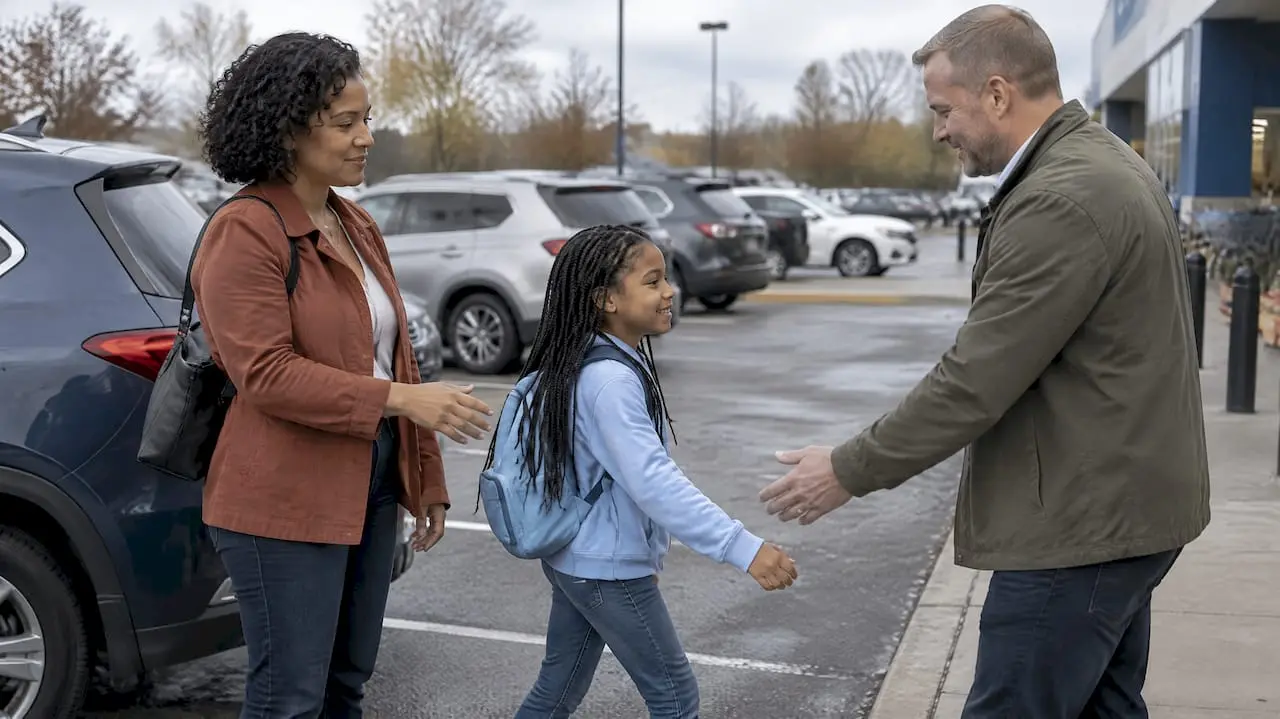
The best custody exchange location is one that is neutral, public or supervised, easy for both parents to reach, and written into your parenting plan by name, day and time. For most families that means the child's school or daycare. For higher-conflict situations it means a busy public place with cameras, a third person, or a supervised exchange program. Whatever you choose, an exchange spot that is vague on paper gets renegotiated at every handoff. A specific one does not.
This guide walks through the main options, when each fits, what to do when safety is a concern, and how to put the decision into an agreement that holds up. If you are drafting a plan yourself, our parenting plan builder lets one parent write a state-specific plan, with exchange terms included, without waiting for the other parent to agree to every line first.
TL;DR
- The simplest exchange is no exchange between parents: school or daycare drop-off and pick-up keeps the parents apart and the child's routine intact.
- Public places work for low-conflict families. Pick somewhere busy, well lit and close to both homes, and avoid either parent's front door when tension is high.
- When there is a history of violence, threats or a protective order, use a supervised exchange program or a trusted third party, and follow what your court order says.
- Write the exact place, day, time, wait period and backup plan into the parenting plan. "A mutually agreed location" invites conflict.
- Children notice the mood at handoffs. A calm, predictable spot protects them as much as it protects you.
Table of Contents
- Why the location matters more than most parents expect
- Common custody exchange locations and when each fits
- How to choose: a practical checklist
- When safety is a concern
- What to write into your parenting plan
- Making handoffs easier on your child
- Our perspective
- Build the exchange terms into your plan
- FAQ
- Sources
Why the location matters more than most parents expect
An exchange is the one moment in a custody schedule when both parents are in the same place at a predictable time. That is why a small disagreement about where to meet can turn into a larger fight.
Children are watching too. The New Mexico Second District Family Court Clinic notes that children read the level of peace or conflict at exchanges and begin anticipating them well in advance. It describes keeping exchanges safe and free of conflict as the parents' joint responsibility, because a hostile handoff puts a child in an unfair position with mixed feelings about both parents.
If your child gets quiet, clingy or irritable around handoffs, the setting may be part of the reason. Understanding your children's stressors can help you notice which parts of a transition upset them most, whether that is a tense conversation in the driveway, a long wait, or an unfamiliar place.
Common custody exchange locations and when each fits
Court guides and family law practitioners list many options. They fall into a handful of types.
| Location type | Best for | Watch out for | |---|---|---| | School or daycare | Any family while school is in session | Needs a plan for weekends, holidays and school breaks | | Public place (store lot, library, restaurant, park) | Low to moderate conflict | Choose busy, lit, with cameras; avoid places that are hard for one parent to reach | | Relative or friend's home | Families with a calm, trusted neutral adult | Both parents must truly trust that person | | Curbside at each home | Cooperative parents who live close | Not recommended when tension or safety concerns exist | | Police station parking lot or lobby | Some higher-conflict cases | Staff generally do not monitor exchanges | | Supervised exchange center | Histories of violence, threats or serious conflict | Availability, rules and fees vary by county | | Third-party exchange (trusted person or professional) | When parents should not meet at all | The third person must be reliable and agreed in writing |
School or daycare
The New Mexico clinic's guide lists school, daycare and school or sport events among its options for exchanges, and it is the one that removes parent-to-parent contact entirely. One parent drops the child off in the morning, the other picks up at the end of the day. The U.S. Department of Justice's safety planning resource for children gives this same pattern as an example of scheduling exchanges without interaction.

The gap is non-school time. Your plan needs a second location for Friday evenings, summer weeks and holidays, and it should say which location applies when.
Public places
A public exchange spot should be busy, well lit and close to both homes. A grocery store lot, a library, a community center or a mall entrance fits the description. Practitioners also suggest thinking about practical comfort: shelter from weather, bathrooms and something to keep children occupied during the handoff. That matters most with toddlers and younger children, who will not wait quietly in a cold parking lot.
Pick a spot roughly midway, or alternate who does the driving, so one parent does not bear all of the travel. Name the exact entrance or parking area, not just the business.
A relative's or friend's home
A grandparent or a friend can host an exchange, or make it on a parent's behalf. This works only when both parents trust that person and believe they will stay out of the dispute. If either parent sees the person as taking sides, choose another option.
Each parent's home
For cooperative families with school-age children, exchanging at the home of the parent who has the child for the longer stretch can be practical. When there is conflict, avoid it. The DOJ resource mentioned above advises against exchanges at either parent's home when safety is a concern, in favor of a safe public place with visibility.
Police stations
Police station lots are a frequent suggestion, and a visible patrol presence and security cameras can discourage bad behavior. They have limits, though. A Missouri family court handbook on child-friendly exchanges cautions that police stations are usually not ideal: officers are often out in the field, staff are not trained to monitor exchanges, and the setting can make a child feel that their well-being is not the parents' top priority. If your case calls for a police station, a parking lot with camera coverage is a common choice. Treat it as a way to add visibility, not as supervision.
Supervised exchange programs
Some counties and nonprofits run safe exchange programs. The Oklahoma County courts explain that in these programs parents generally arrive and leave at different times or through different doors, so they never meet, and a staff member brings the children from one parent to the other. Before the first exchange, staff meet each parent separately to review the court order, exchange terms, safety procedures, documentation and fees, and then both parents sign an agreement.

Costs differ by place. In Charlotte, for example, Safe Alliance says the Mecklenburg County Supervised Visitation and Safe Exchange Center is free if one parent lives in the county. Your own county may have a program, a fee scale, or a waiting list, so ask your family court clerk what exists locally.
How to choose: a practical checklist
Use these questions to narrow the options down.
- What is the conflict level? If you can speak civilly, a public place or school is fine. If conversations escalate, remove the face-to-face contact.
- Is there any safety concern? Violence, threats, stalking, substance use or a protective order change the whole analysis. See the section below.
- How far is it for each parent? An exchange spot that adds 40 minutes for one parent builds resentment. Fairness in travel makes the arrangement last.
- Is it comfortable for the child? Think about the child's age, the weather, bathrooms, and whether the child has to wait.
- Can both parents get there reliably? Check parking, transit and hours. A library that closes at 6 p.m. will not work for a 6:30 p.m. handoff.
- Is there a backup? Pick a second location for closures, bad weather or a child who is sick.
The exchange location is also tied to how much time each parent has and how the schedule is built. If you are working out a 50/50 arrangement, see the pressure points of 50/50 custody with a high-conflict ex, since the number of handoffs drives how much the location matters.
When safety is a concern
If there has been abuse, threats, stalking or a protective order, the exchange is a risk point, and the decisions below should involve your attorney, a domestic violence advocate, and the court. Call 911 in an emergency. The National Domestic Violence Hotline can help you plan around your situation.
The measures that courts and safety resources commonly describe include:
- No contact between parents. The DOJ guidance suggests bringing a trusted friend or family member, or having them make the exchange, and scheduling exchanges so the parents do not interact.
- Neutral locations and third-party exchanges. An Iowa guide on responding to intimate partner violence in custody cases lists court tools such as requiring neutral exchange locations like a school or place of business, requiring third-party exchanges, restricting visits to a set area, and defining consequences for non-compliance.
- Supervised exchange. A professional provider keeps the parents apart and documents what happens.
Professional providers operate under standards. California's court rules, for example, say providers must make every reasonable effort to assure safety, and they should have written emergency protocols with local law enforcement, written security procedures, and a screening process at intake. The same standard says that, unless the court orders otherwise, providers keep contact within sight and hearing, refuse exchanges when a party appears under the influence of alcohol or drugs, and avoid discussing the court case with the child. Those are California rules, but they show what a well-run program looks like. Other states have their own.
Where substance use is part of the picture, the exchange terms should connect to the sobriety provisions in your plan. Our article on substance abuse in custody cases covers that. For safety clauses courts tend to recognize, see domestic violence and parenting plans.
In all of these situations, your court order controls. If an order names a location or a third party, follow it exactly, and ask your attorney or the court before changing anything.
What to write into your parenting plan
A good exchange clause removes decisions. It does not leave anything to be "worked out" at the curb. Include:
- The exact location. Name the business, the address and the spot, for example the north entrance of a specific library.
- The day and time. State it for each handoff, including holidays and summer.
- Who transports. Say who drives for pick-up and who for drop-off, or how you alternate.
- Wait time. Specify how long a parent waits for a late arrival before the handoff is treated as missed, and what happens next. Safe Alliance's guidance stresses that a detailed plan leaves less room for manipulation or ambiguity, and notes overlooked situations like illness at exchange time and how long to wait at the meeting spot.
- A backup location. Say when it applies: closure, weather, or an emergency.
- Communication. Decide how parents confirm a late arrival or a change. Keep messages short and about logistics. Our communication clause page explains how to set that up.
- Third parties. If a grandparent or program makes exchanges, name them and say what happens if they are unavailable.
- Special needs. Cover medications, comfort items, car seats and anything else that travels with the child.
Compare two ways of saying the same thing. "The parents shall exchange the children at a mutually agreed location" leaves every handoff open to dispute. "Exchanges occur at the main entrance of the Oak Street Library on Fridays at 6:00 p.m.; the receiving parent waits 20 minutes; the backup is the library's side parking lot" leaves nothing to argue about.
Once the plan is drafted, it generally needs to be filed or approved by a court to be enforceable. Our page on filing a parenting plan with the court explains that step in general terms, and rules differ by state.
Making handoffs easier on your child
A few habits make any location work better:
- Keep the handoff short and predictable. Same place, same time, same routine.
- Do not use the exchange to discuss money, schedules or the other parent. Save it for written communication.
- Greet your child warmly and keep your tone neutral toward the other parent, even when you are not feeling neutral.
- Pack a consistent bag, so belongings do not become a source of argument.
- Let the child bring a favorite item between homes.
If you find yourself shaking after a handoff, you are not alone. Our guide on regulating your nervous system during a high-conflict divorce offers techniques for the minutes before and after, and handling co-parenting disputes calmly covers what to do when a disagreement starts at the exchange itself.
Our perspective
Most parents come to us after a handoff went wrong: a late arrival turned into an argument, or a "mutually agreed location" stopped being mutual. The pattern is almost always the same. The plan left a gap, and the conflict moved into it.
We built CoParent Navigator so that one parent can draft a complete, state-specific parenting plan on their own, using a library of research-backed clauses, instead of negotiating every detail across a kitchen table or through lawyers by the hour. Exchange terms are exactly the kind of detail that benefits from that approach: location, time, wait period, backup, who communicates and how. Putting them in writing early takes the decision out of the moment when emotions are highest.
The platform also gives you a secure workspace to keep communication and documentation in one place, so there is a clear record when something needs to be shown to a mediator, an attorney or a court. And because our legal guidelines are regularly updated, the plan you build reflects your state's rules.
A calm exchange is not a luxury. It is part of how a child feels safe in two homes.
Heather
Build the exchange terms into your plan
If you are ready to put your exchange location in writing, CoParent Navigator helps you draft a personalized parenting plan for your state from a library of research-backed clauses. One parent can start the draft independently, and the secure workspace keeps your communication and documentation together.

Start on the CoParent Navigator home page, or try the free co-parenting tools first. Mediators can see our tools for mediators and attorneys can see our resources for attorneys.
FAQ
What is the safest place for a custody exchange?
There is no single answer, because it depends on your situation. For most families the safest exchange is at school or daycare, where parents never meet. When there is a risk of violence, a supervised exchange program or a trusted third party is the usual choice, along with whatever your court order requires. If you are in danger, contact your attorney or a domestic violence advocate, and call 911 in an emergency.
Can we exchange the kids at a police station?
Many parents do, and the visible security and cameras can calm things down. Keep in mind that officers are often out on calls and station staff do not monitor exchanges, so a police lot adds visibility rather than supervision. If your case needs actual oversight, ask the court about a supervised exchange program.
Who decides the exchange location if we cannot agree?
If you cannot agree, a mediator can help, and a judge can set the location in the custody order. It is much easier to settle the question while drafting the plan than after a dispute begins. A written plan that names the place, day and time gives a court something specific to approve and enforce.
Do custody exchange centers cost money?
It depends on the program. Some are free for county residents, and others charge fees, which the program reviews with each parent before the first exchange. Contact your county family court or clerk to find programs near you and ask about fees and rules.
What if the other parent does not show up to an exchange?
Your plan should say how long to wait and what counts as a missed exchange. Keep a written record of the time, the place and your attempts to reach the other parent, and follow the steps in your order or plan. If missed exchanges are a pattern, talk to your attorney or mediator about next steps.
Sources
- Time Sharing Schedules, New Mexico Second District Family Court Clinic
- Safety Planning with Children, U.S. Department of Justice
- Tips for choosing a custody exchange drop off spot
- Child Friendly Exchange Handbook
- Safe Exchange, Oklahoma County courts
- How to Co-Parent with an Abuser, Safe Alliance
- Responding to IPV in Custody and Visitation Cases: Iowa
- Standard 5.20, California Courts
- Understanding Your Children's Stressors
Recommended
- Joint Custody Arrangements: What Actually Works Best for Your Family
- Custody Schedule Examples: 7 Rotations and How to Choose
- Create a Custodial Plan
- Legal Custody vs Physical Custody Explained
Informational only, not legal advice. Review filing, approval and enforceability requirements with a qualified professional in your jurisdiction.
Start building your parenting plan today
Build a complete parenting plan with CoParent Navigator, the child-centered way to a custody agreement that holds up.