Child Medical Expenses in a Custody Agreement: What to Write
12 min readBy the CoParent Navigator team

A custody agreement should name who carries the child's health insurance, how premiums are shared, how every uninsured cost is split, and how one parent repays the other. Leave any of those four blank and the first orthodontist bill or therapy invoice becomes a fight. Our platform lets one parent draft a state-specific parenting plan with those clauses already structured, so the money questions are settled in writing before they come up.
TL;DR
- Cover four things: who provides insurance, who pays the premium, how uninsured costs are split, and how reimbursement works.
- Basic child support may already include a small allowance for routine care in your state. Check that before you write a separate clause, so you don't pay twice or leave a gap.
- Define "medical" broadly: dental, vision, orthodontia, prescriptions, therapy and mental health, not only doctor visits.
- Set deadlines for sending bills and for repayment. Many state forms use 30 days.
- Use clear, case-specific wording. Vague terms are the ones that end up before a judge.
Table of Contents
- What counts as a child medical expense
- What child support may already cover
- Step 1: Decide who provides health insurance
- Step 2: Split the premium
- Step 3: Divide the uninsured costs
- Step 4: Set the decision-making rules
- Step 5: Build a reimbursement routine with deadlines
- If the other parent doesn't pay
- Where our platform fits
- Our perspective
- Start your expense clauses
- FAQ
- Sources
What counts as a child medical expense
Most agreements and court orders sort medical costs into three groups. The federal Office of Child Support Enforcement (OCSE), in its guidance for attorneys, describes health insurance, ordinary medical expenses and extraordinary medical expenses as the usual categories. Copays, medicines, procedures insurance won't cover and cash payments made in place of insurance all fall under this umbrella.
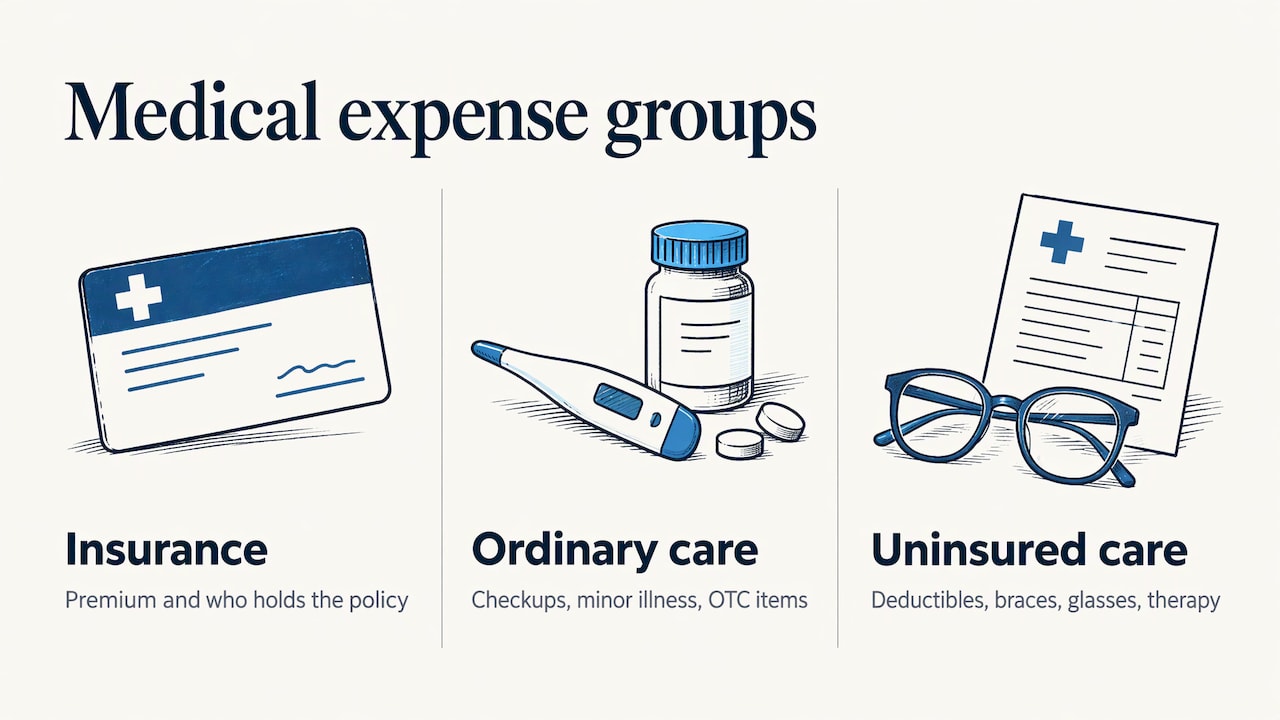
Insurance. The premium, and who actually holds the policy.
Ordinary expenses. Routine, predictable care such as checkups, minor illnesses and everyday over-the-counter items.
Extraordinary or uninsured expenses. Deductibles, coinsurance, braces, glasses, specialist care, therapy, and anything above what the policy pays.
The definition you choose matters. Ohio's court-approved shared parenting plan form uses a broad one that names medical, dental, orthodontic, optical, pharmaceutical, hospital, psychological, psychiatric, therapy, counseling, prosthetic and preventive care. Michigan's court administration likewise lists professional or prescribed care, equipment and medicines for oral, visual, psychological, medical, dental and orthodontic needs. If your agreement says only "medical expenses," a parent can argue that counseling or an eye exam was never covered. Name each category.
What child support may already cover
Before you split uninsured costs, find out what basic child support already includes. States differ.
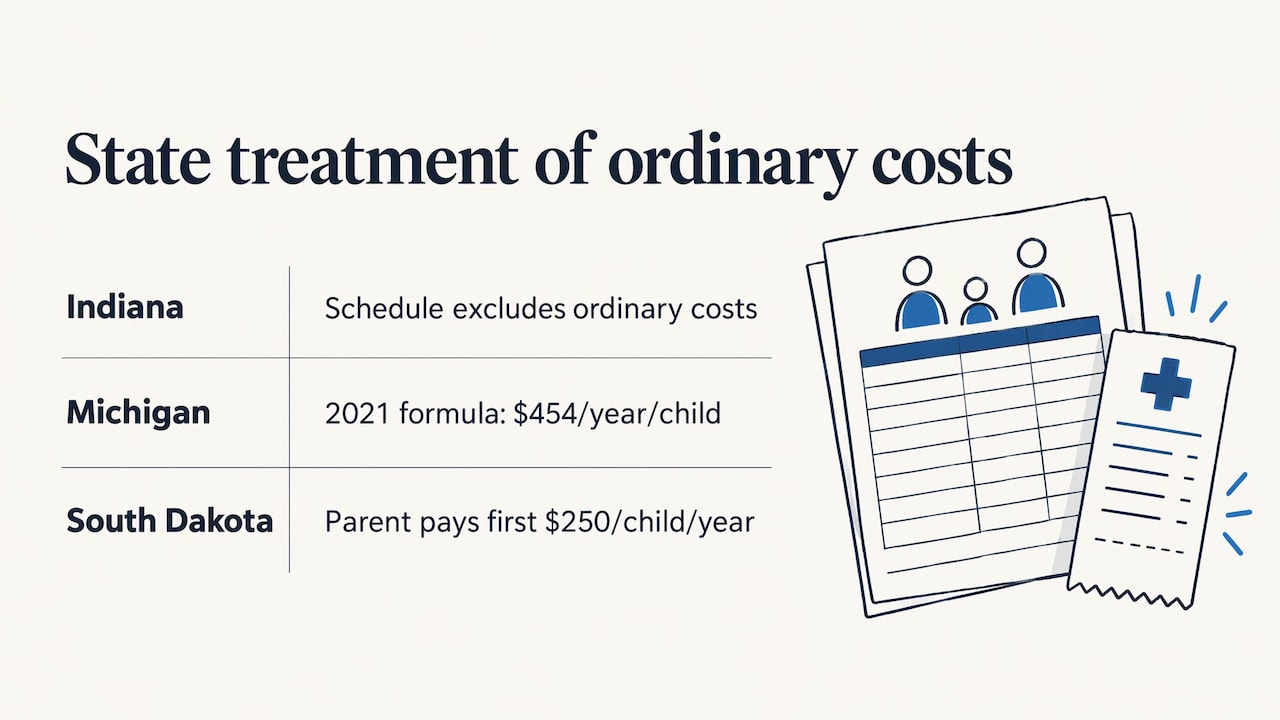
Indiana's guideline says its current schedule no longer includes ordinary health-care costs. Routine household items such as bandages and over-the-counter products stay with the parent who buys them. Indiana's Guideline 7, effective January 1, 2024, spells this out: vitamins, nonprescription medicines and bandages kept at a parent's home are that parent's responsibility during their parenting time.
Other states build a small allowance into basic support. Michigan's 2023 court memorandum describes an annual ordinary medical amount of $454 for one child under its 2021 formula, with costs above that treated as additional expenses subject to reimbursement. South Dakota's agreement form gives an example in which the primary-custody parent pays the first $250 per child per year, and costs above that are divided by percentages.
The practical lesson: do not copy a clause from another state. A threshold that makes sense in Michigan may double-count in a state whose support formula works differently. Our parenting plan builder is designed around state-specific rules for this reason. For the larger picture of how support relates to everything else you pay for, see why child support is the floor, not the ceiling.
Step 1: Decide who provides health insurance
Federal rules require state guidelines to address how parents will provide for a child's health care through private or public coverage, cash medical support, or both. Federal rules also direct states to seek accessible, reasonably priced coverage and allocate its cost between the parents. When coverage isn't available, agencies must seek cash medical support until it is.
State rules put this in practical terms:
- Indiana's guideline says coverage should normally come from the parent who can obtain the most comprehensive coverage at the least out-of-pocket cost, and it must be accessible where the child lives.
- Florida's Department of Revenue says that when only one parent has accessible, reasonably priced coverage, that parent is generally ordered to provide it. If both qualify, the lower-cost plan is chosen. If neither does, neither is ordered to insure the child.
- Wisconsin's example of affordability uses a 10% of income measure for the cost of adding children to employer coverage.
- California's court self-help guidance says parents should agree which parent provides insurance when it is available at reasonable cost, and may allocate uncovered expenses separately from child support.
If you live in Florida, this walkthrough of health insurance and child support in Florida shows how an order assigns coverage and divides the premium.
Write the answer into the agreement in specific terms. Michigan's court administration recommends that orders identify the parent responsible for coverage, the reasonable premium cost, each parent's premium share, the coverage type and the source of insurance. It adds that this specificity reduces duplicate coverage, confusion and enforcement disputes.
Step 2: Split the premium
The premium is a recurring cost, so a vague sentence causes monthly friction. Some states build it into the support calculation. Others handle it by statute: Utah's code, for orders issued or modified on or after May 3, 2023, requires equal sharing of the child's actual premium cost and of reasonable uninsured medical and dental costs, subject to statutory exceptions.
Whatever your state's default, state in the agreement:
- Which parent holds the policy.
- The child's portion of the premium (not the whole family premium, if the policy covers others).
- Each parent's percentage.
- Whether the paying parent gets a credit in the support calculation or is reimbursed monthly.
- What happens if the policy changes or the employer drops coverage.
The parent providing insurance also has paperwork to do. South Dakota's form requires that parent to give the other an insurance card or copy with policy and covered-person details within 30 days. Without it, the other parent can't take the child to urgent care with confidence.
Step 3: Divide the uninsured costs
Uninsured costs are what remains after insurance pays: deductibles, copays, coinsurance, prescriptions, and services the plan excludes. Indiana defines them as costs remaining after an insurance claim is submitted, including deductibles and amounts above policy limits, and shares them in proportion to the parents' incomes.
The common methods:
| Method | How it works | Where it fits | |---|---|---| | Income-share percentage | Each parent pays a share matching their share of combined income | Indiana's approach; Michigan's default, with each share held between 10% and 90% unless the parties agree otherwise | | Equal split | 50/50 | Utah's statutory default for orders issued or modified after May 3, 2023, with exceptions | | Threshold plus percentage | One parent pays the first fixed amount per year, then costs are split by percentage | South Dakota's form example | | Set dollar amount or percentage | The order fixes either an amount or a share | Wisconsin allows either, and enforcement differs by form |
Pick one method and apply it to every category, including dental and prescriptions. Wisconsin's guidance notes that uninsured costs include dental and prescription costs, which people often assume are handled elsewhere.
If your child has a disability or chronic condition, general language is not enough. The American Bar Association's Family Law Quarterly argues that children with disabilities may have extensive therapies, equipment and out-of-pocket costs, so plans should expressly address specialized and uncovered care. Our guide on special-needs co-parenting and continuity covers how to write that continuity into the plan. For families planning long-term in-home care, understanding what Medicaid may pay for medically fragile children in Georgia shows why that planning belongs in the agreement.
Step 4: Set the decision-making rules
Money disputes are often decision disputes. A parent who scheduled braces without asking is likely to hear "I never agreed to that." Good agreements address:
- Provider selection. Maryland's parenting plan instructions direct parents to address how providers are chosen and how each parent is notified of or included in medical exams and elective-care decisions.
- Consultation before non-routine care. Ohio's form provides for parental participation in provider selection, notice of emergencies and consultation before major non-emergency care.
- Emergencies. Either parent can consent to emergency treatment and must notify the other promptly.
- Records access. Each parent can reach the child's medical records and insurance information.
- Covered versus uncovered providers. The ABA article recommends terms on emergency care, joint choice of non-emergency providers, records access and a clear reimbursement process.
A useful rule: expenses a parent approved in advance, or emergency expenses, are shared. Elective or non-routine expenses incurred without consultation are the deciding parent's problem unless the other agrees afterward. Say which in writing.
Step 5: Build a reimbursement routine with deadlines
The most common failure is not the percentage, it is the paperwork. Build deadlines into the agreement.
- South Dakota's form calls for documented deductible or uninsured expenses to be reimbursed within 30 days of written notice unless the agreement says otherwise.
- Indiana requires expense and insurance-claim documents to be sent within 30 days of receipt. Expenses paid at the time of service should be submitted within 30 days, or contribution may be unavailable.
- Ohio's form calls for sharing bills or explanations of benefits within 30 days.
A workable routine: the paying parent sends the bill and the insurer's explanation of benefits in writing. The other parent pays their share within the agreed number of days. Both keep a running record. Keep notes factual: amount, date, provider, what insurance paid. Our piece on removing five words from your documentation shows how neutral wording protects you if a record is ever reviewed.
If the other parent doesn't pay
Enforcement depends on your state and on how the order is written.
- Michigan. The 55th Circuit Friend of the Court says to request payment within 28 days of the insurer's final payment or denial, with bills and explanations of benefits. If it's unpaid after another 28 days, you may request enforcement, subject to filing deadlines.
- Alaska. Court self-help guidance says a parent can use court forms to request payment of unpaid child health expenses and may seek a judgment for what they already paid, then pursue collection against assets or wages.
- Virginia. The state's child-support agency enforces insurance orders through employer National Medical Support Notices and can enforce cash medical support when the order states a dollar amount. A 2025 state report notes that disputes about individual unreimbursed bills may require court adjudication.
Wisconsin shows why drafting matters: a set-dollar medical obligation can be enforced by the child-support agency, while percentage-based expenses may need a family-court motion. A precise clause gives you the easier route. A clear dispute clause helps too; see what to write in a dispute resolution clause.
Where our platform fits
A medical-expense clause has to match your state's rules and your family's facts. A parent can draft the plan alone on CoParent Navigator, using a library of research-backed clauses and state-specific legal guidelines that are regularly updated. The plan can then go to the other parent or to mediation with the numbers and deadlines already written down. The same secure workspace holds communication and documentation, so bills, explanations of benefits and payment requests stay in one place. For an overview of how the expense sections fit together, read who pays for what in a parenting plan.
Attorneys and mediators can use the platform to structure these terms with clients through our resources for attorneys.
Our perspective
Medical costs are where good intentions meet real invoices. Two parents can agree on everything about the schedule and still end up in conflict over a $400 orthodontic bill, because nobody wrote down who decides, who pays first, and how fast the other must repay.
We built CoParent Navigator around the idea that one parent should be able to put a complete, state-specific plan on paper without waiting for the other parent to cooperate. That matters most in the expense sections. When the plan names the coverage parent, defines every category of care, sets the split and gives a deadline, there is little left to argue about, and a mediator or judge has something concrete to review.
The official forms agree on the basics: written notice, documentation, a stated deadline. A template that skips them leaves you with vague promises. A plan that is tailored to your state and your child is a contract you can actually follow.
Take the expense section as seriously as the schedule. It is the part you will use every month.
Heather
Start your expense clauses
If you are drafting or revising a plan, start with the medical section. Build your parenting plan, with state-specific clauses for insurance, uninsured costs and reimbursement, at CoParent Navigator.

You can also try our free co-parenting tools for schedules and support calculations, and read why you should never accept a template parenting plan handed to you at court.
FAQ
Does child support cover my child's medical expenses?
Sometimes partly. Some states include a small allowance for routine care in basic support, while others, like Indiana, have removed ordinary costs from the schedule. Insurance premiums and uninsured costs are usually handled separately, so check your state's guideline and write the split into your agreement.
Which parent has to carry the child's health insurance?
It depends on the state, but the common test is which parent can get accessible coverage at reasonable cost. Indiana looks to the parent who can obtain the most comprehensive coverage at the least out-of-pocket cost. Florida orders the parent with accessible, reasonably priced coverage, and picks the lower-cost plan if both qualify.
How should we split deductibles, copays and prescriptions?
The usual choices are a split proportional to income, an equal split, or a yearly threshold paid by one parent followed by a percentage split. Apply the same method to dental, vision, therapy and prescriptions so no category is left undefined.
How long does the other parent have to repay me?
It is set by your order or agreement. South Dakota's form uses 30 days from written notice with documentation, and Michigan's Friend of the Court guidance uses 28-day windows for the request and follow-up. Put a specific number of days in your own agreement.
Sources
- OCSE Essentials for Attorneys, Chapter Ten
- Indiana Child Support Guideline 7
- Michigan Supreme Court medical support memorandum
- Ohio Uniform Domestic Relations Form 20
- South Dakota stipulation and agreement form
- Florida Department of Revenue insurance FAQ
- Wisconsin DCF medical support orders
- California Courts self-help agreement guidance
- Utah child support guidelines
- Maryland parenting plan instructions
- ABA Family Law Quarterly on parenting plans for children with disabilities
- 55th Circuit Friend of the Court medical support guidance
- Alaska Court System enforcement self-help
- Virginia medical support report, September 2025
- Health insurance and child support in Florida
- Georgia Medicaid and medically fragile children
Recommended
- Who Pays for What: The Complete Expense Architecture of a Parenting Plan
- Child Support Is the Floor, Not the Ceiling
- Dispute Resolution Clause for a Parenting Plan: What to Write
- Custody Agreement vs. Parenting Plan: What Differs
Informational only, not legal advice. Review filing, approval and enforceability requirements with a qualified professional in your jurisdiction.
Start building your parenting plan today
Build a complete parenting plan with CoParent Navigator, the child-centered way to a custody agreement that holds up.